

A journey into Tibetan architectural wisdom and the spaces that heal

xd wang
Feb 9, 2026
xd wang
UI/UX Specialist
Framer & Aura template expert Helping founders launch websites in 7 days. Google-certified UX designer focused on high-conversion templates. Exclusive template
Follow Author
Related Posts




When Light Falls, the Heart Finds Its Place
What 10 years of working on the Tibetan plateau taught me about designing spaces that calm the nervous system
Have you ever walked into a space and immediately felt your shoulders drop, your breathing slow, and your mind quiet? Maybe it was a library, a chapel, or a friend's living room with just the right light. You've experienced architectural healing—the power of physical space to shift your inner state. For most of us, it happens by accident. But what if we could design for it intentionally?
After a decade of working as an architect on the Tibetan plateau, I've learned that healing spaces aren't accidents. They're the result of centuries-old spatial wisdom, encoded in walls, windows, and the precise choreography of light and shadow. The Tibetan people have been practicing architectural psychology for over a thousand years—not as theory, but as survival.
This is the story of what those spaces taught me about anxiety, attention, and the nervous system. And why, in our over-stimulated modern world, we need this ancient knowledge more than ever.

Less light, more clarity.
Anxiety has become the background noise of modern life. When we feel lost and helpless, we instinctively search for something—a method, a practice, a different way of living—that might guide us out of our trouble。 For over a decade, I‘ve been searching too. But I wasn’t looking in self-help books or meditation apps. I was looking in walls, in shadows, in the way light falls through a monastery window at 4,000 meters above sea level.
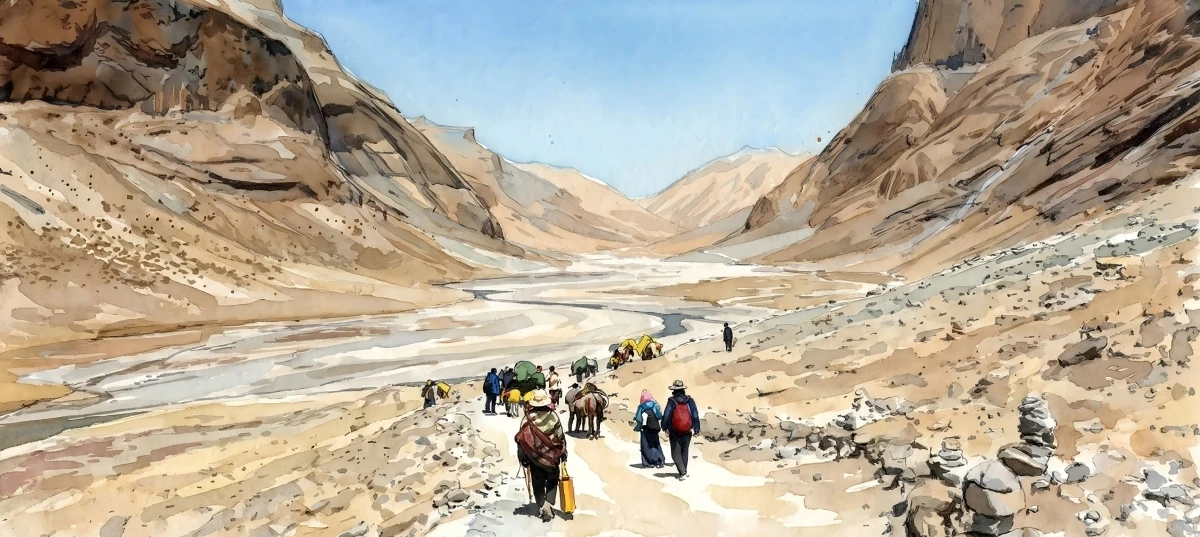
I'm an architect and planner who has spent more than ten years working across the Tibetan plateau. I came initially with blueprints and technical drawings. I stayed because I kept encountering something I couldn't measure: a quality of space that made anxiety feel optional.
The Tibetan people have lived on this harsh, oxygen-thin plateau for over a thousand years, yet they've maintained something many of us have lost—not the absence of suffering, but a different relationship with it. Worry exists everywhere; what differs is how we hold it. And I began to realize: their architecture isn't just shelter from the elements. It's a technology for sheltering the mind.
I've always believed this: some forms of peace don't come from "figuring things out." They come from stepping into the right space, where calm simply happens to you.
It's a weightless moment, yet utterly certain—like a hand gently pressing down on your restless nerves. You haven't gained more answers, yet suddenly you stop needing to prove anything. You haven't accomplished any goal, yet you find yourself thinking: I can stay here for now.
In many interior spaces across the Tibetan plateau, I've encountered this peace again and again. It often begins with a scene so simple it feels almost luxurious: darkness, thick walls, pillars, floating dust, a single beam of light falling to the floor. The light isn't there to illuminate every corner. It seems to whisper: Don't rush. Start here.
What the Plateau Taught Me About Spatial Healing
Anxiety has become the background noise of modern life. When we feel lost and helpless, we instinctively search for something—a method, a practice, a different way of living—that might guide us out of our trouble。 For over a decade, I‘ve been searching too. But I wasn’t looking in self-help books or meditation apps. I was looking in walls, in shadows, in the way light falls through a monastery window at 4,000 meters above sea level.
I'm an architect and planner who has spent more than ten years working across the Tibetan plateau. I came initially with blueprints and technical drawings. I stayed because I kept encountering something I couldn't measure: a quality of space that made anxiety feel optional.
We live in an over-lit, over-stimulated era. Light is everywhere: screen light, street light, the light of information, the light of social connection. They illuminate the world with perfect clarity, yet leave us increasingly unable to sleep, to focus, to truly be still. We think we're in control of our lives, but we're more often pushed along by external forces—jumping from one notification to another, sliding from one worry to the next. Our nervous systems are in constant overdrive.
The Tibetan people have lived on this harsh, oxygen-thin plateau for over a thousand years, yet they've maintained something many of us have lost—not the absence of suffering, but a different relationship with it. Worry exists everywhere; what differs is how we hold it. And I began to realize: their architecture isn't just shelter from the elements. It's a technology for sheltering the mind.
On the plateau, I learned to read a different language. Not the language of blueprints, but of cosmology made tangible. The Tibetan worldview—shaped by mandala principles, oriented toward sacred mountains like Mount Kailash (Gang Rinpoche), structured by the ancient science of Sa Che (geomancy)—isn't abstract philosophy. It's encoded in every monastery courtyard, every rammed-earth wall, every carefully positioned window.
These aren't just buildings. They're instruments for nervous system regulation.
The Science Behind Spatial Healing
The wisdom of Tibetan spaces lies not in making you "stronger." It lies in making you whole. Thick walls don't just insulate against cold; they create acoustic and visual boundaries that allow your nervous system to stop scanning for threats. Small windows don't just conserve heat; they frame the world into manageable portions, teaching your attention to focus rather than scatter. Circumambulation paths don't just honor the sacred; they give your restless body a repetitive rhythm that gradually quiets the mind.
This is what I call mindful architecture—design that understands how physical space directly affects mental states. Through architecture and the play of light and shadow, these spaces perform a gentle training: slowly bringing your scattered mind back to your body, your floating thoughts back to the ground. This is spatial healing—not as metaphor, but as material fact.
Modern environmental psychology is only now catching up to what Tibetan builders have known for centuries: our spaces shape our consciousness. The thickness of a wall, the size of a window, the quality of light—these aren't just aesthetic choices. They're interventions in your nervous system's constant negotiation with the world.
An Architect's Journey Into Healing Spaces

This book is not a professional treatise on Tibetan architecture. It's not a guide telling you how to live. It's something more personal: a record of what these spaces taught me about anxiety relief, and an invitation for you to experience them too.
Over ten years of working on the plateau—measuring sites, consulting with communities, sitting in monastery halls during breaks, watching how light moves through a room across seasons—I began to notice patterns. Not just architectural patterns, but psychological ones. Certain spatial qualities consistently produced certain inner states. The relationship wasn't mystical; it was almost mechanical. Like a tuning fork that makes other objects vibrate at the same frequency, these contemplative spaces tuned something in me.
I want to share that frequency with you.
You'll see monastery pillar halls where darkness teaches patience. Small windows in traditional homes that frame the world into bearable portions. The texture of rammed-earth walls that absorb sound and anxiety alike. Circumambulation corridors where repetitive movement becomes moving meditation. The unique interplay of light and shadow at high altitude, where thin air makes every beam of sunlight feel like a physical presence.
But I hope what you take away isn't "style" or "exotic aesthetics." I hope you understand: why these elements bring us peace. Why thick walls aren't just about insulation. Why small windows aren't just about heat conservation. Why the mandala-based layout of a monastery isn't just religious symbolism, but a technology for organizing attention and intention—a form of architectural psychology practiced for millennia.
The spaces I'll share aren't curiosities from a distant culture. They're ancient, tested responses to universal human struggles: the need for containment when we feel scattered, for rhythm when we feel chaotic, for darkness when we're overstimulated, for a center when we've lost our way. These are stress reduction principles built into stone and earth.
What We'll Explore Together: A Map for Mindful Living
In the chapters ahead, we'll examine how architectural elements—thick walls, narrow windows, massive columns, enclosed courtyards—work not just as physical structures but as psychological instruments for mental health. We'll look at how materials matter: why rammed earth feels different from concrete, why natural light heals differently than artificial light, why certain proportions calm us while others agitate.
We'll explore the cosmological framework that shapes these meditation spaces: the mandala as organizational principle, the sacred mountain as orientation point, the Sa Che system as a way of reading landscape and energy. Not as religious doctrine, but as spatial intelligence accumulated over millennia—a form of biophilic design before the term existed.
And we'll consider what all this means for us—people living in over-stimulating cities, working in fluorescent-lit offices, sleeping in rooms that never get truly dark. This isn't about replicating Tibetan monastery design in your apartment. It's about understanding the principles beneath the forms, so you can recognize—or create—spaces that reduce anxiety, allow your nervous system to settle, your attention to deepen, your heart to find its place.
Think of this as interior design for the soul—where every architectural choice becomes an act of self-care.
A Journey Into Sacred Architecture and Self-Discovery
I'm writing this as someone who came to the plateau with technical expertise and left with something harder to name. Call it spatial wisdom. Call it architectural healing. Call it simply: learning to read what spaces do to us, and choosing better containers for our consciousness.
This book is my attempt to take you on that journey. Not as tourists collecting exotic images, but as fellow travelers learning to see differently. Because sometimes, the most profound healing doesn't come from doing more, acquiring more, or understanding more. It comes from finding the right container, stepping inside, and allowing what's already within you to finally rest.
The Tibetan people have lived with this wisdom for over a thousand years, not by erasing suffering, but by building spaces that teach us how to hold it. Their architecture survived because it works—not just as shelter, but as medicine for the restless modern mind. In an age of anxiety, their contemplative design offers us something precious: permission to slow down, to dim the lights, to find peace in enclosure rather than endless expansion.
Join This Journey: Your Next Steps
If this resonates with you, here's how to continue:
🔖 Follow me for the next chapter: "The Architecture of Darkness: Why Less Light Means More Clarity" — where we'll explore how Tibetan monasteries use shadow as a tool for focus and why our over-lit world is making us anxious.
💬 Share your experience: What spaces make you feel most at peace? Have you ever walked into a room and felt your anxiety dissolve? Comment below—I read and respond to every thoughtful reflection.
🌟 Spread the calm: If someone in your life is struggling with anxiety or overstimulation, share this article. Sometimes the most helpful thing we can offer isn't advice, but a different way of seeing.
📚 This is Part 1 of a series exploring Tibetan architectural wisdom for modern living. Upcoming chapters will cover:
The psychology of thick walls and why containment heals
How to apply mandala principles to your home or workspace
The neuroscience of natural materials and sensory design
Creating your own "monastery moment" in urban spaces
A final thought:
You don't need to travel to Tibet to experience healing spaces. You need to learn to read space differently. Once you understand the principles—how light quality affects mood, how wall thickness impacts nervous system regulation, how proportions influence attention—you'll start noticing them everywhere. And more importantly, you'll start creating them in your own life.
Bring your anxiety, your restlessness, your scattered attention to the next chapter. These ancient spaces know what to do with them.
— xd wang\ Architect, spatial researcher, Urban Planner, UX/UI Designer
Tags for this article: #MentalHealth #Architecture #Mindfulness #Anxiety #TibetanCulture #SpatialDesign #Wellness #InteriorDesign #ArchitecturalPsychology #HealingSpaces
#WebDesign
#Framer
Impact-Site-Verification: 338ad259-3a0b-476c-a467-cb119844ba7d