
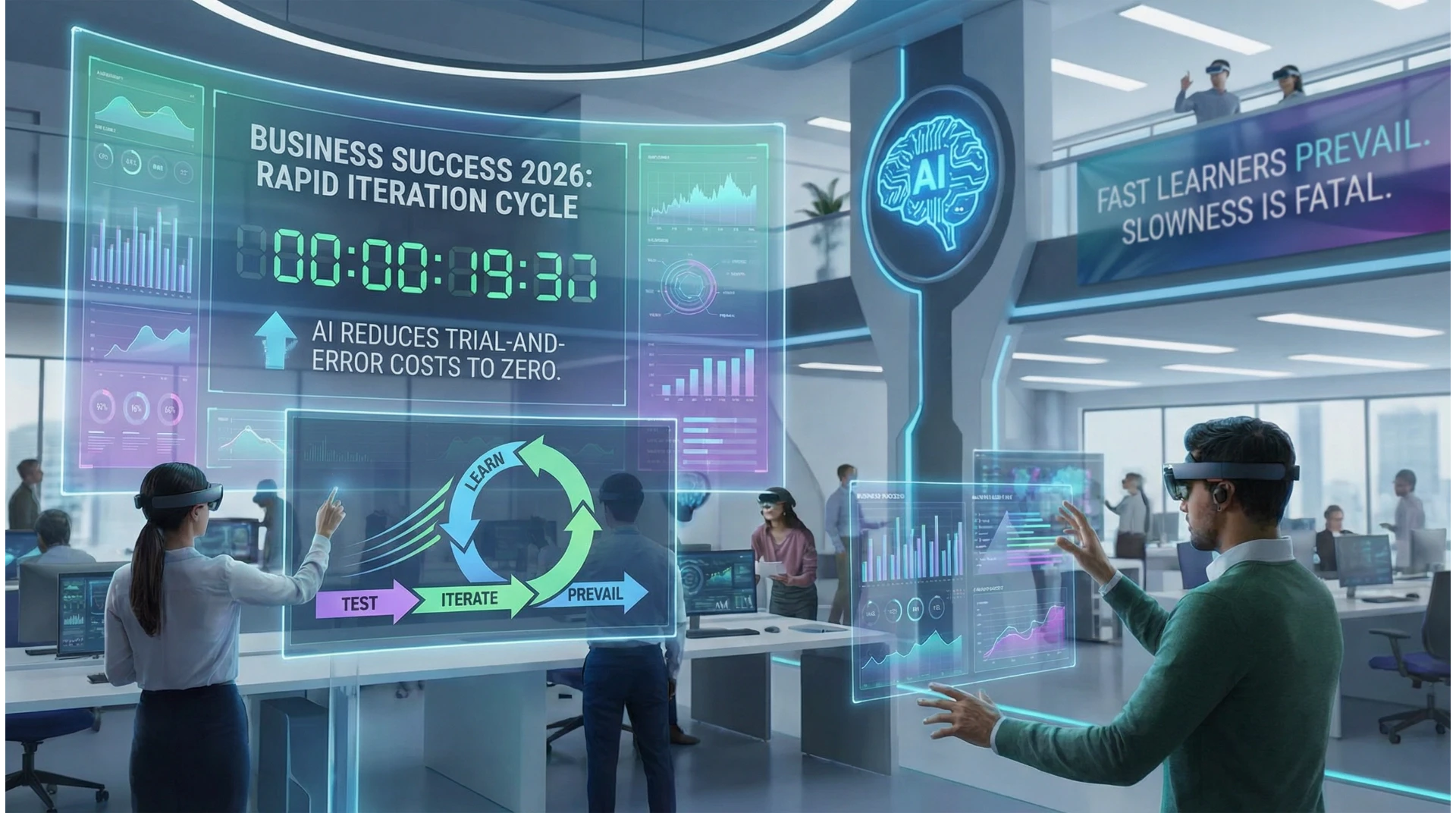
The key to business success in 2026 lies in rapid iteration Rapid testing and data-driven learning become the only competitive advantage—fast learners prevail.

xd wang
xd wang
UI/UX Specialist
Framer & Aura template expert Helping founders launch websites in 7 days. Google-certified UX designer focused on high-conversion templates. Exclusive template
Follow Author
Related Posts

Speed is the Only Moat: Why Rapid Iteration Will Define Business Success in 2026
Let me start with a confession: I spent the better part of 2019 convincing a client that their landing page absolutely needed six weeks of development time. Custom animations, pixel-perfect responsive design, A/B testing infrastructure—the works. We delivered something beautiful. Something that took so long to perfect, by the time it launched, three competitors had already tested five variations each and found what actually worked.
I'm not bitter about it. I'm enlightened.
Because what we're witnessing isn't just the automation of web design—it's the complete transformation of competitive advantage. And if you're running a small company heading into 2026, understanding this shift might be the difference between thriving and becoming irrelevant.
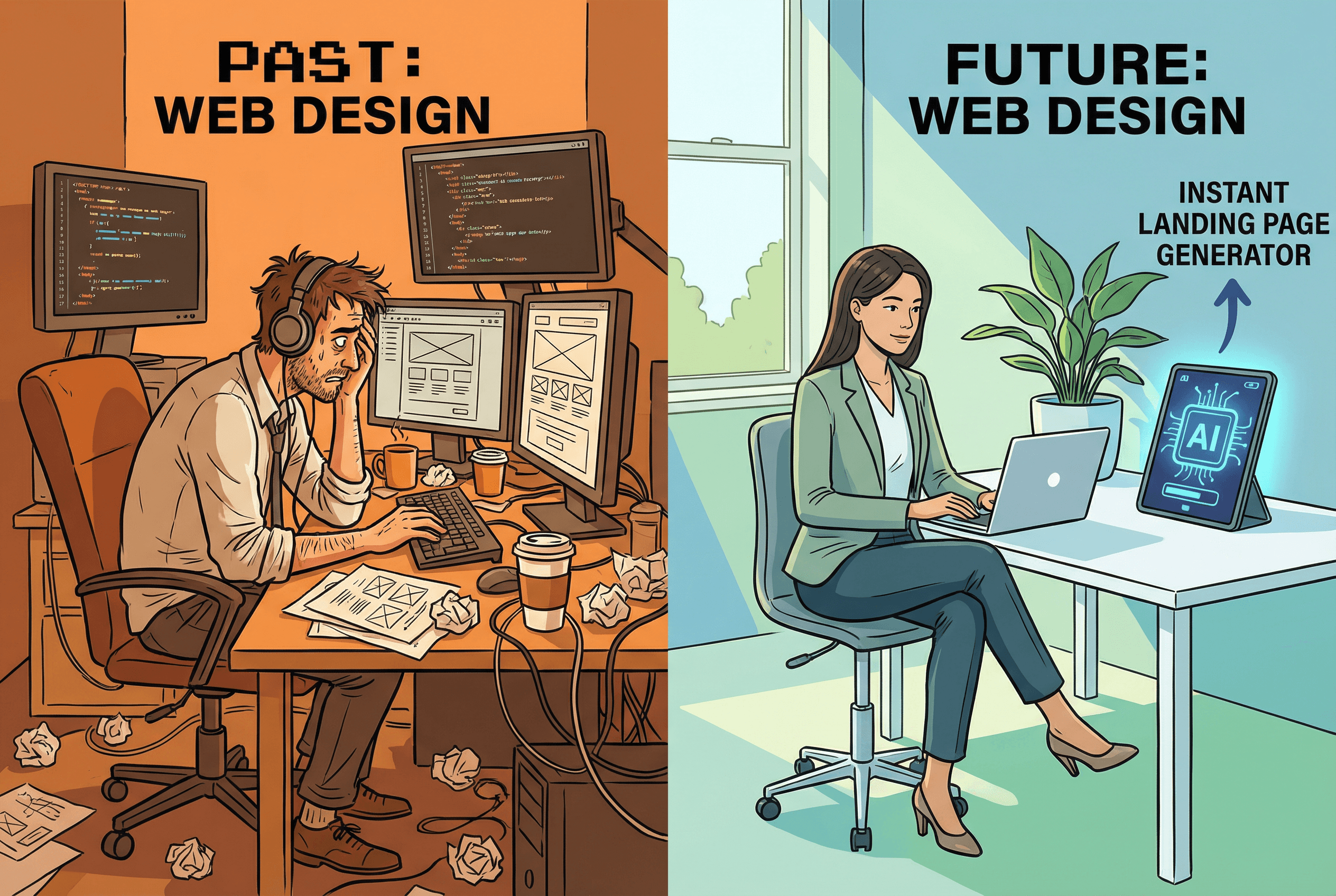
The Old Game vs. The New Game
Let's talk about what really matters: velocity.
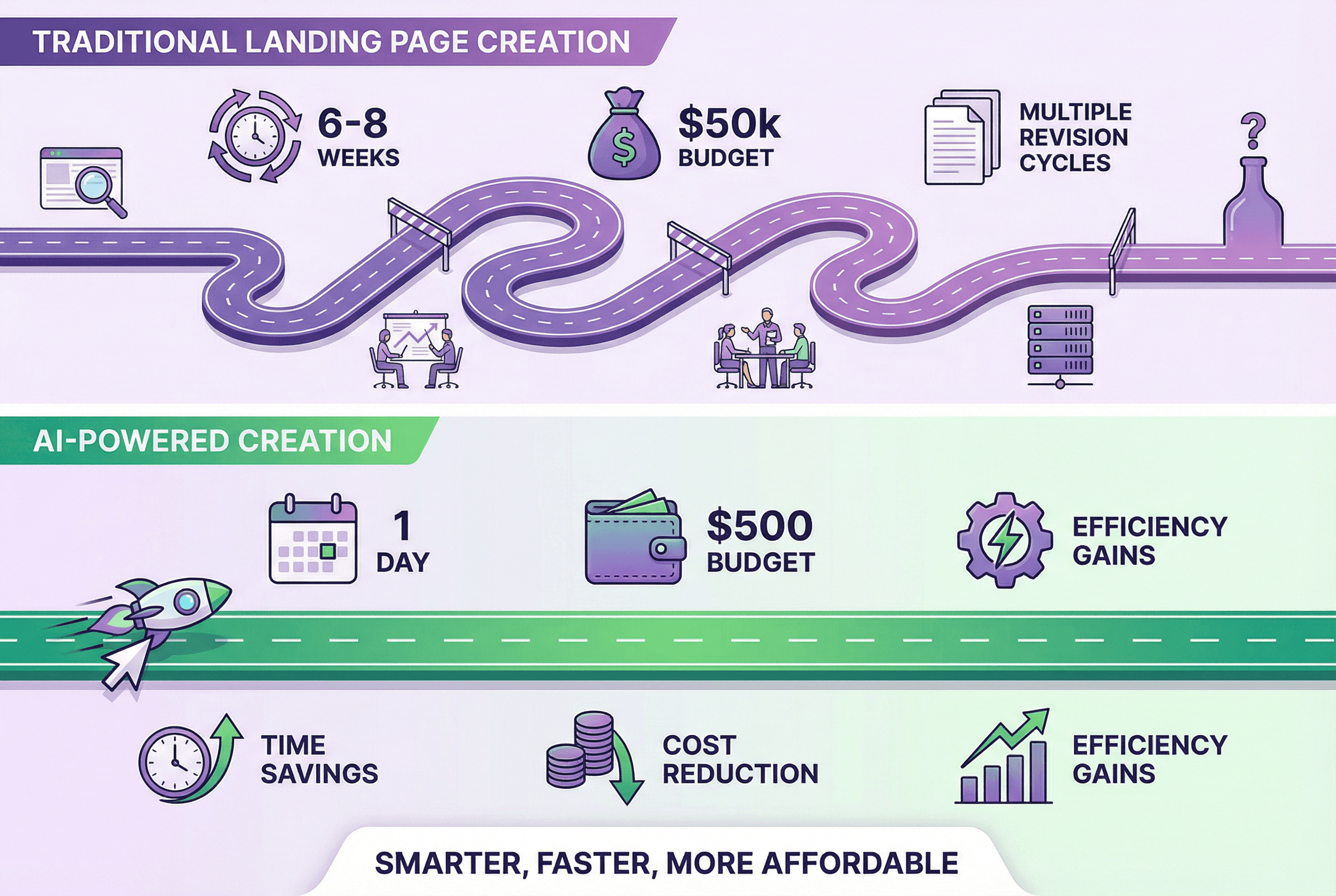
Traditional Landing Page Timeline (2020-2023):
Discovery & wireframing: 1 week
Design iterations: 2-3 weeks
Development: 2-3 weeks
QA & revisions: 1 week
Total: 6-8 weeks for ONE version
Cost: $8,000-20,000 depending on complexity
AI-Powered Landing Page Timeline (2026):
Initial AI generation with Gemini 3: 30-45 seconds
Design refinement & customization: 2-4 hours
Component integration & testing: 2-3 hours
Final polish & deployment: 1-2 hours
Total: 1 day for ONE version
But here's the kicker: You can create 10 variations in the same timeframe
That's not about cost savings. It's about competitive velocity.
While your competitor is perfecting their single landing page, you've tested ten different approaches, gathered real user data, and already know what works. By the time they launch, you're three iterations ahead.
Why Speed Became the Only Moat That Matters
Here's what changed between 2023 and 2026: the cost of being wrong dropped to zero, while the cost of being slow became fatal.
In the old world, you had to get it right the first time because iteration was expensive. You'd spend weeks in planning meetings, debate color choices, workshop copy, and pray you made the right decisions.
In 2026? You don't need to get it right. You need to get it out there and learn fast.
The Darwin Principle of Digital Business
Companies that survive 2026 will share one trait: adaptation speed.
Not the best design. Not the biggest budget. Not the most experienced team.
The ability to test, learn, fail fast, and iterate.
Think about it:
Market conditions shift weekly, not quarterly
User preferences evolve in real-time
Competitors launch new approaches daily
What worked last month is already outdated
The only sustainable advantage is learning velocity—how fast you can detect what's not working and pivot to what does.
Gemini 3 and the Velocity Revolution
I'll be honest—when Gemini first launched, I was skeptical. The outputs were generic, the color choices were predictably purple, and the UI patterns were derivative.
Then Gemini 3 arrived, and suddenly the game changed completely.
What changed? Context awareness and creative interpretation.
But more importantly: generation speed that enables true experimentation.
The difference isn't just quality—it's that you can now generate 20 variations of a landing page concept in the time it used to take to have one design meeting.
The Three Pillars of Speed-First Design in 2026
1. Inspiration-Driven Reference Systems
Modern AI tools don't work in a vacuum. They're trained on millions of design patterns, but more importantly, they can remix based on your specific references.
Screenshot a layout from Dribbble? Upload it. Found a color scheme you love on a competitor's site? Feed it in. Have your own brand guidelines? The AI adapts everything to match.
The result: You're not starting from zero. You're starting with multiple viable options in under an hour.
2. Iterative Refinement That Actually Enables Experimentation
Here's what most people miss about AI design tools: they remove the friction from iteration.
You generate a hero section. It's 70% there. You adjust typography, try different animations, switch layouts. Each iteration takes seconds, not days.
The workflow becomes: Generate → Test → Learn → Regenerate → Test Again.
This isn't about perfection—it's about finding what actually works through rapid experimentation.
3. The Component Economy Accelerates Everything
AI tools now come with comprehensive component libraries—buttons, cards, forms, footers, hero sections—all pre-built, all customizable, all production-ready.
You don't spend three days building a pricing table. You test five different pricing table designs in three hours and see which converts better.
Speed compounds. Every minute not spent on basics is a minute spent learning what your users actually respond to.
The Real-World Impact: Speed as Strategy
Case Study 1: The Adaptable Founder
Maria, SaaS Startup Founder
Maria's project management tool launched into a crowded market. Her advantage? Not a better product—faster adaptation.
Old approach: Spend 6 weeks perfecting one landing page based on assumptions about what users want.
2026 approach:
Day 1: Generated 8 different landing page concepts with Gemini 3
Week 1: Launched all 8 variations, rotated them randomly, tracked metrics
Week 2: Doubled down on the top 2 performers, generated 5 variations of each
Week 3: Found the winning combination—something she never would have guessed
Month 2: Competitors still on their first design iteration
Result: 4.7% conversion rate (they tested to find what worked), not because the design was "better," but because they found what actually resonated through rapid iteration.
Case Study 2: The Agency Evolution
TechForward, 8-Person Design Agency
Facing existential pressure, they pivoted from "designers who make beautiful things" to "teams that help clients learn fast."
New workflow:
Generate 10-15 initial concepts in first client meeting (no more "we'll get back to you in two weeks")
Launch multiple variations simultaneously
Gather real user data within 48 hours
Iterate based on actual behavior, not opinions
Client capacity increased 400% because speed became the product
Result: More clients, but more importantly—better outcomes because decisions are data-driven and fast.
Case Study 3: The Enterprise Wake-Up Call
MidCorp, 500-Employee Manufacturing Company
Traditional quote for 12 product line landing pages: $120,000, 4-month timeline.
But the real cost? Four months of zero market learning.
AI-powered approach:
Week 1: Generated 3 variations for each product line (36 total pages)
Week 2: Launched all variations in rotation, gathered data
Week 3: Refined winning variations, killed underperformers
Week 4: Optimized based on real conversion data
Result: Not just money saved—three months of market learning gained while competitors were still in design reviews.
But What About Quality?
Here's the question everyone asks: "Isn't this just creating mediocre designs faster?"
Short answer: No, because market feedback is the ultimate quality control.
Long answer: The definition of "quality" changed.
In the old world, quality meant pixel-perfect execution, beautiful aesthetics, and flawless implementation.
In 2026, quality means: Does it convert? Does it resonate? Does it work?
And you can't answer those questions in Figma. You answer them in production, with real users.

What AI Can't Do (Yet):
Understand nuanced brand voice and market positioning
Make strategic decisions about user flow and conversion optimization
Interpret user behavior patterns and market signals
Navigate stakeholder relationships
Decide which experiments to run next
What Humans Do in 2026:
Strategic experiment design
Interpretation of test results
Pattern recognition across multiple iterations
Brand narrative consistency
Decision-making about what to double-down on
The human role evolved from execution to strategic orchestration. You're not making the pixels pretty—you're deciding what to test next based on what you learned.
The 2026 Toolkit: Speed-First Infrastructure
If you're a small company preparing for this shift, here's your practical velocity stack:
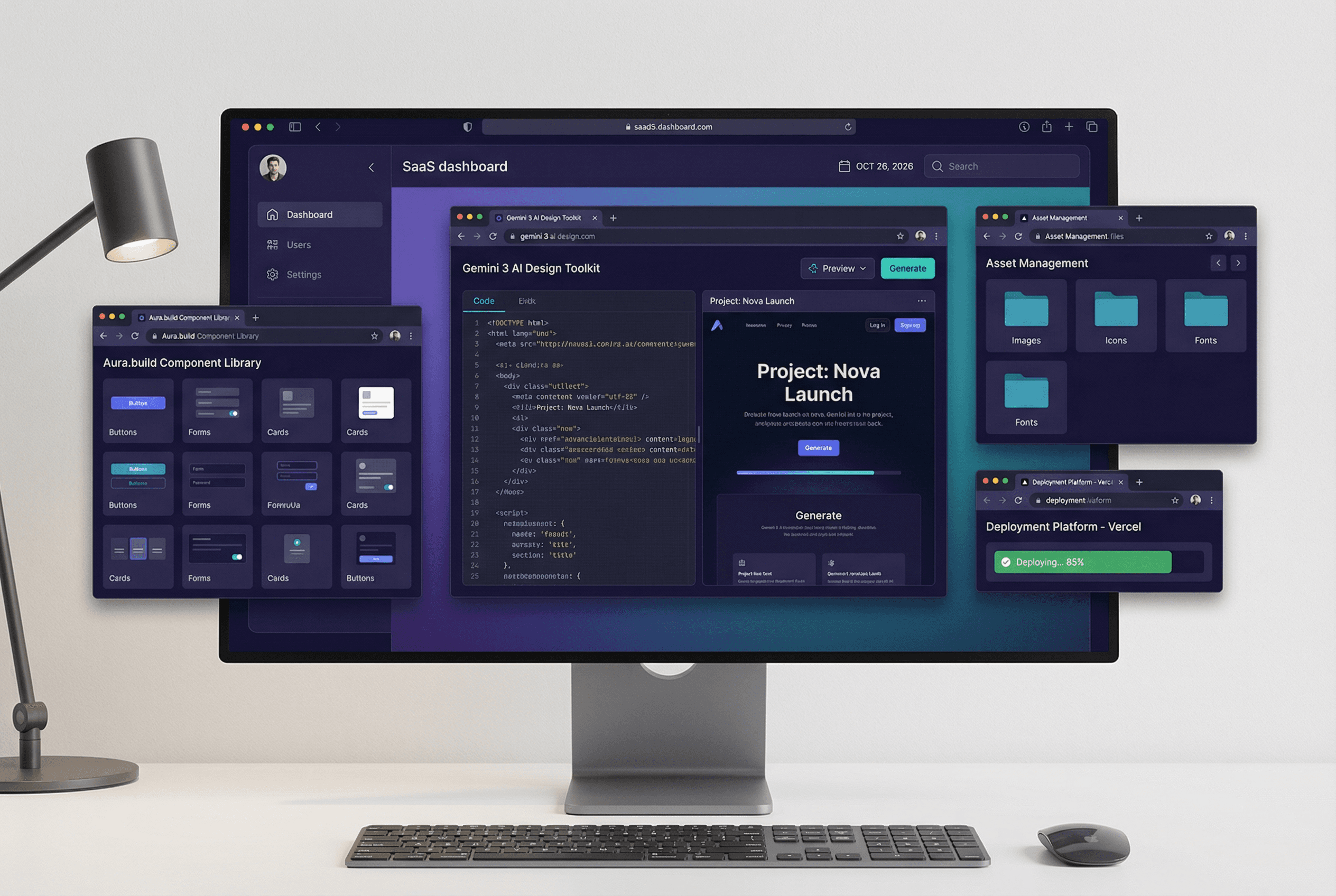
Essential Speed Tools
1. AI Design Generator (Gemini 3 or similar)
Core design generation
Rapid variation creation
Style adaptation
Cost: ~$20-50/month
2. Component-Based Platform
Template libraries for speed
Pre-built, customizable components
Quick export to production frameworks
Cost: ~$30-80/month
3. Asset Libraries
Unsplash/Pexels for rapid imagery
Icon libraries for instant visuals
Background generators
Cost: Free to $20/month
4. Fast Deployment Infrastructure
Vercel, Netlify, or similar
Instant previews for every variation
Cost: Free to $20/month for small sites
5. Analytics & Testing Framework
Real-time conversion tracking
Multi-variant testing capability
User behavior analytics
Cost: Free to $50/month
Total monthly investment: $70-220
But the real investment is mindset: You're not buying design tools. You're buying learning velocity.
The Speed-First Workflow
Week 1: Generation
Generate 10-15 initial concepts based on research and references
No perfection—just viable starting points
Launch all variations in rotation
Week 2: Learning
Gather real user data from all variations
Identify top 2-3 performers
Kill underperformers without emotion
Week 3: Iteration
Generate 5 variations of winning concepts
Test new hypotheses based on Week 2 learnings
Continue learning cycle
Week 4+: Acceleration
Double down on proven patterns
Test increasingly refined variations
Build learning library for future projects
The pattern is continuous: Generate → Deploy → Learn → Iterate → Repeat.
The Patterns You Must Avoid
Speed without strategy is just chaos. Here are the traps:
The "Endless Tinkering" Trap
When generation is free, you'll be tempted to keep tweaking forever.
Solution: Set strict time limits. 4 hours for refinement, then deploy. Learn from real users, not your own opinions.
The "Analysis Paralysis" Syndrome
Having 20 variations doesn't help if you can't decide which to test.
Solution: Test everything. Literally. Deploy all variations in rotation and let data decide.
The "No Strategic Direction" Problem
Rapid iteration without strategy is random motion, not progress.
Solution: Each iteration should test a specific hypothesis. "Does emotional copy convert better than feature-focused copy?" Answer one question per cycle.
The "Ignoring Fundamentals" Disaster
Speed doesn't mean skipping accessibility, mobile responsiveness, or basic UX principles.
Solution: Build quality controls into your rapid generation process. Every output must meet baseline standards.
Speed as Competitive Moat: The New Reality
Here's what 2026 taught us: In a world where everyone has access to the same AI tools, execution speed is the only remaining advantage.
Two companies have identical access to Gemini 3. Identical budgets. Identical market opportunities.
Company A: Spends 6 weeks perfecting one landing page.Company B: Tests 30 variations in 6 weeks, learns from real data.
Company B wins. Every time.
Why? Because they've learned what actually works while Company A is still guessing.
The implications:
A/B testing isn't optional—it's baseline survival behavior
You should test weekly, not quarterly
Your landing page from last month is already obsolete
The "perfect" design doesn't exist—only the current best performer
What You Should Be Testing Constantly
Multiple hero section layouts (5+ variations minimum)
Different value propositions (what resonates changes weekly)
Various color schemes (psychological impact varies by context)
Alternative CTA copy and placement
Competing imagery approaches
Different social proof presentations
Varied pricing displays
And you should be testing all of this simultaneously, not sequentially.
The Skills That Matter in 2026
Technical skills matter less. Strategic skills matter more.
Nice to Have:
Basic HTML/CSS understanding
Familiarity with design principles
Component-based thinking
Critical to Have:
Hypothesis formation: What should we test next and why?
Data interpretation: What is this telling us about user behavior?
Ruthless prioritization: Which experiments matter most?
Pattern recognition: What works across multiple tests?
Speed discipline: When to stop refining and start learning?
The best performer in 2026 isn't the best designer. It's the fastest learner.
The Survival Mindset
We need to talk about what this means for businesses:
The old competitive advantages are dead:
Better design? Everyone has AI now.
Bigger budget? Doesn't buy you learning speed.
More experienced team? Experience from 2023 doesn't apply to 2026's reality.
The new competitive advantages:
Faster learning cycles
Better experimentation discipline
Stronger data interpretation
Clearer strategic direction
More ruthless focus
The companies that survive 2026 will be those that:
Test more ideas per week than competitors test per month
Kill failed experiments without emotional attachment
Double down on winners faster than market conditions change
Learn from users, not assumptions
Iterate before perfecting
This isn't about having better tools. It's about using speed as strategy.
Your 30-Day Speed Transformation
If you're a small company preparing for 2026, here's how to build learning velocity:
Days 1-7: Speed Infrastructure
Days 8-14: Rapid Experimentation
Days 15-21: Data-Driven Iteration
Days 22-30: Velocity Optimization
Budget allocation:
AI tools & platforms: $150-250
Analytics & testing infrastructure: $50-100
Deployment: $20-50
Learning budget: $100 (for courses, resources)
Total: $320-500
But remember: You're not buying tools. You're buying the ability to learn faster than your competition.
2026: Adapt or Die
I'll leave you with this thought: We're entering an era where survival is a function of adaptation speed.
For the first time in business history, the barrier isn't capital, connections, or capability—it's learning velocity.
A solo founder who can test 50 landing page variations in a month will outcompete a Fortune 500 company that takes three months to approve one design.
The barriers to entry are gone. The excuses are gone. The "we need more time to perfect it" argument is gone.
What remains is stark: Can you learn faster than your market changes?
Because 2026 won't be won by those with the best first attempt. It'll be won by those who make the most attempts, learn the fastest, and adapt before anyone else realizes the game changed.
Speed isn't just an advantage anymore.
Speed is the only moat left.
The question isn't whether you can afford to move fast. It's whether you can afford not to.
How is your company adapting to the speed-first reality? What's your biggest barrier to rapid iteration? Share your thoughts—I'm genuinely curious about how businesses are navigating this fundamental shift.
#WebDesign
UX/UI
#Framer
Impact-Site-Verification: 338ad259-3a0b-476c-a467-cb119844ba7d